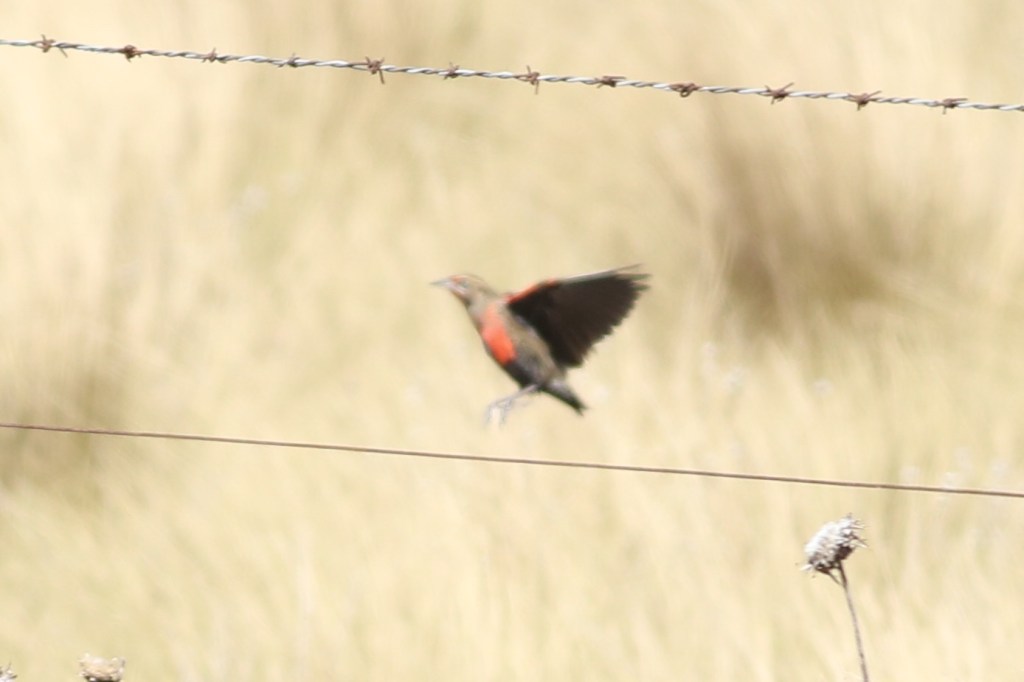
The sun beat down on the brim of my hat as I stared out at the endless flat pasture, broken only by a few cottonwood trees on the horizon. It was almost noon. Another group of Long-tailed Meadowlarks was foraging along a barbed-wire fence by the roadside, so I watched as they flew back and forth between the fence posts and the bone-dry earth. I’d already looked at dozens of these birds along the 12 miles of road I’d walked that morning, in the hopes of finding one with chocolate-colored under-wings instead of white. Wing color is the most reliable way to tell the difference between the Long-tailed Meadowlark (which can be seen throughout southern South America) and the Pampas Meadowlark (which can only be seen within 50-mile radius from where I was currently standing, along with a couple of small populations in Uruguay and Brazil). One bird flew up and it looked just a little different than the others. I grabbed for my camera and snapped a picture as it swooped up to the fence…
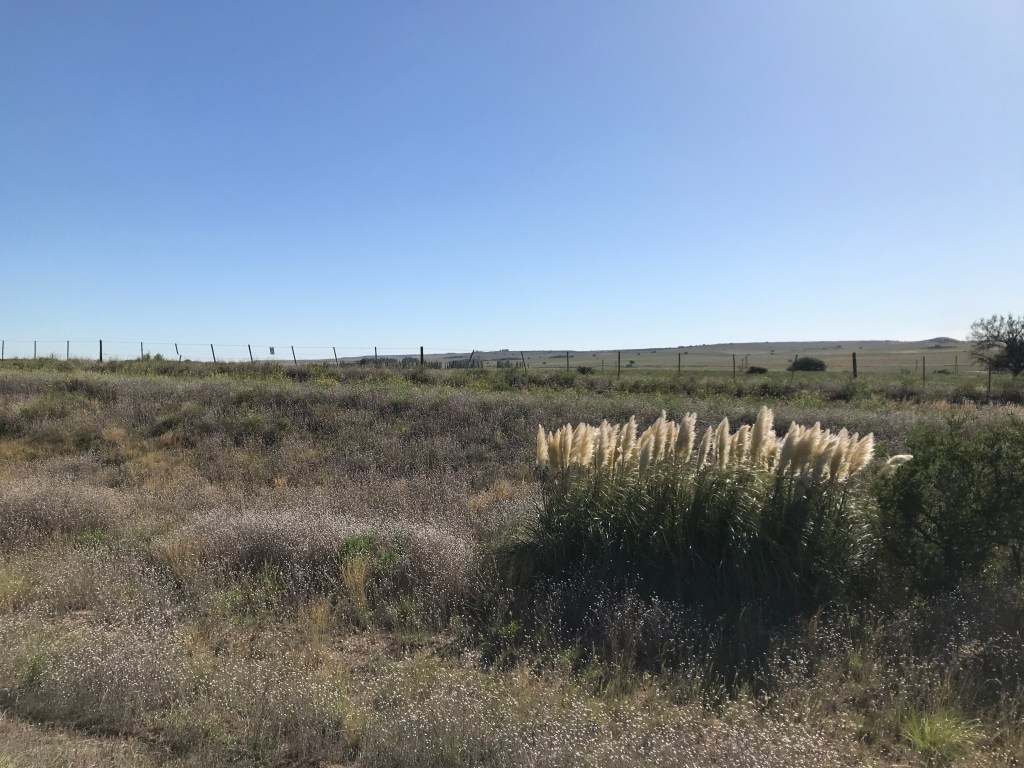
The Pampas is the enormous grassland ecosystem in eastern Argentina, Uruguay and far southern Brazil. It’s got Rheas (South American Ostrich relatives), Pampas Grass (yes, the same stuff planted outside every shopping center in the US), and a whole lot of cattle. The Pampas Meadowlark probably used to be incredibly common throughout this region, but due to habitat degradation they’re now one of the world’s most range-limited birds. This is odd for a meadowlark; in the US we have 2 common species which ADORE cow pasture. I’ve even heard some people conjecture that humans have increased meadowlark populations in the US by clearing so much land for cattle. But, as the Cornell Lab points out, “the Pampas Meadowlark is unique among meadowlarks” in its failure to flourish in the cow pasture that used to be its home turf—it’s declined nearly to the point of disappearance.
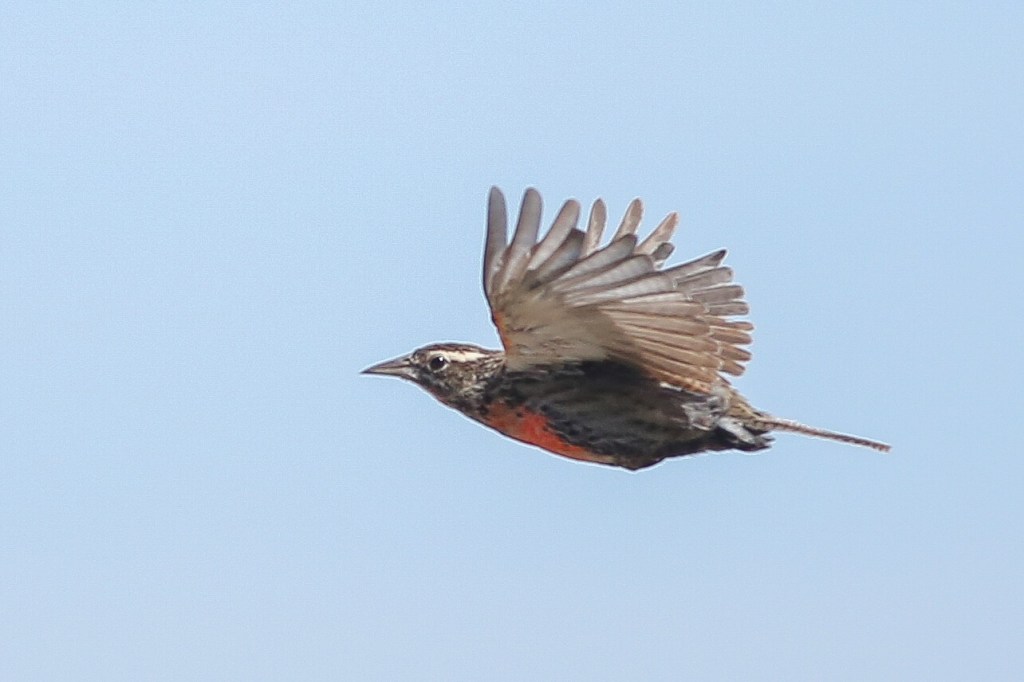
So I was very excited when I looked at my camera and saw this:
I had been at the point of turning back for about an hour when I saw it. I had left my hostel at 5am, caught two buses across the city to the end of the bus line, and then started walking into the countryside. I had checked eBird and the closest sightings to Bahia Blanca were out along this road, Ruta 35. My plan was to walk and hitchhike out to the area where the bird was most often seen, and walk that portion of road until I either saw one or ran out of water.
Fortunately, most folks headed out of the city were extremely considerate and as soon as I stuck my thumb out someone slowed down. Unfortunately they were being considerate enough to let this poor tourist know that he was headed in the wrong direction, and they gestured vigorously to the other side of the road where I SHOULD have been hitchhiking to go back into town. Headed in my direction there was little to no human habitation for at least a hundred miles, and after that there wasn’t much of anything for tourists to do. So I smiled big and waved as driver after driver passed me, trying to let me know that I should be on the other side of the road.
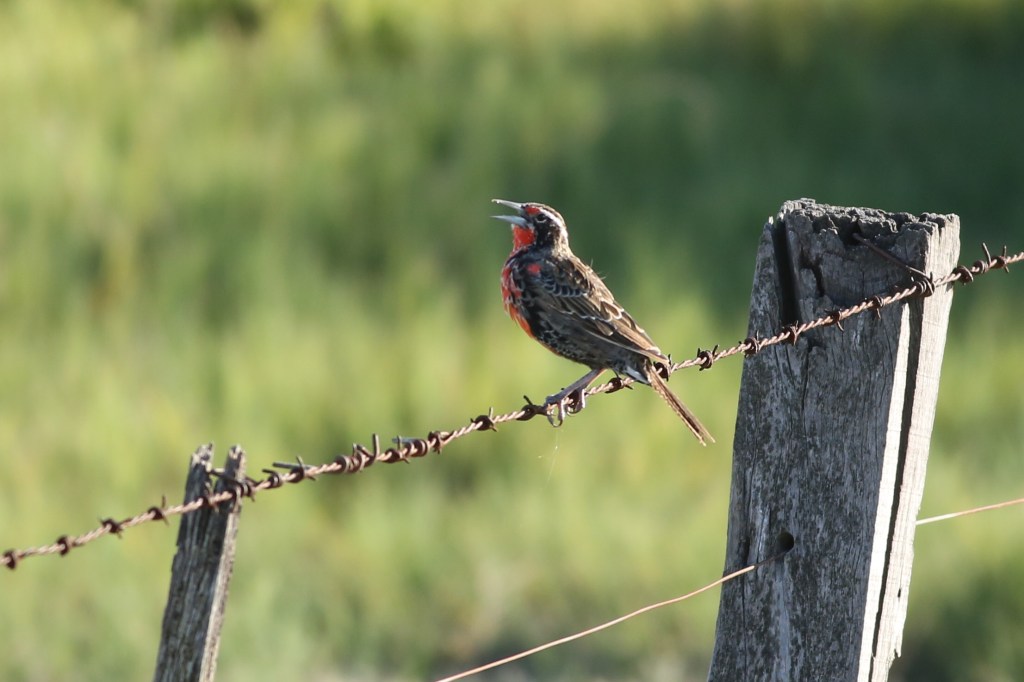
I wasn’t far out of town when I spotted my first Long-tailed Meadowlark. A truly spectacular bird that I’ve wanted to see ever since I saw a print of this picture hanging on the wall of the Cornell Lab in NY. I was pretty stoked.
After about 7 miles of walking a van finally hit the brakes and my heart skipped a beat. I hopped in and had a nice chat about birds with Claudio, who I think was running a shuttle from Bahia Blanca to a tiny settlement called Choique (the local word for Rhea). He, like most folks I’ve encountered in Argentina so far, was amused and kind of excited that I was here to look for birds. He dropped me off after about 15 miles, roughly where the eBird sightings were for the Pampas Meadowlark. I started walking again.
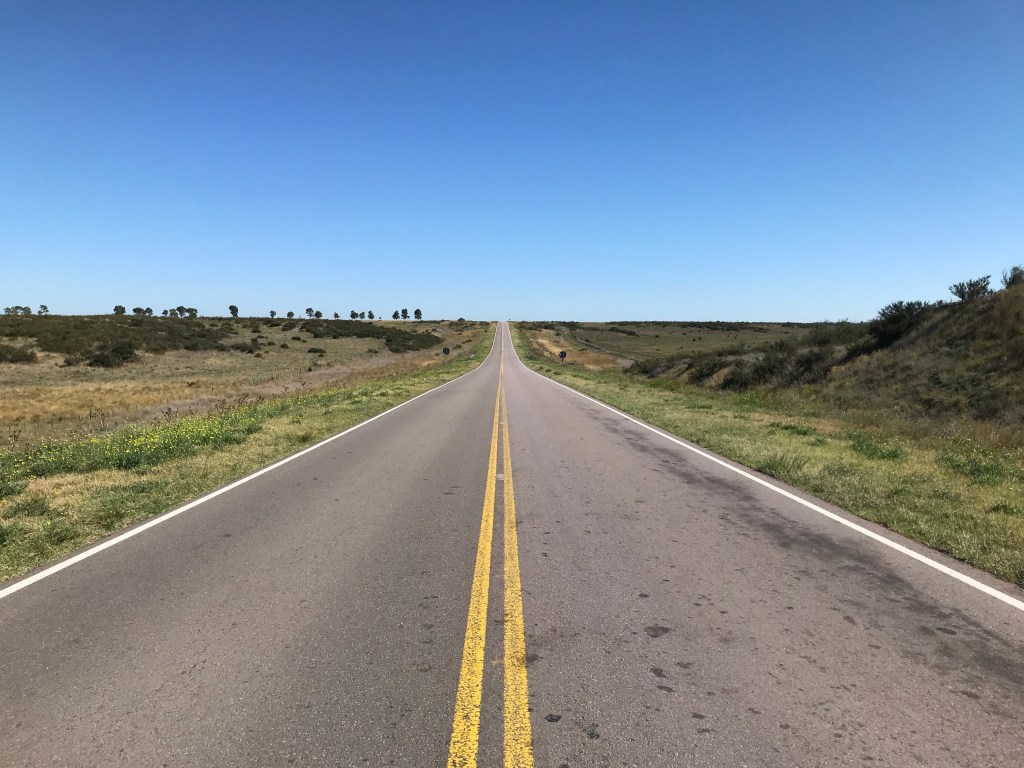
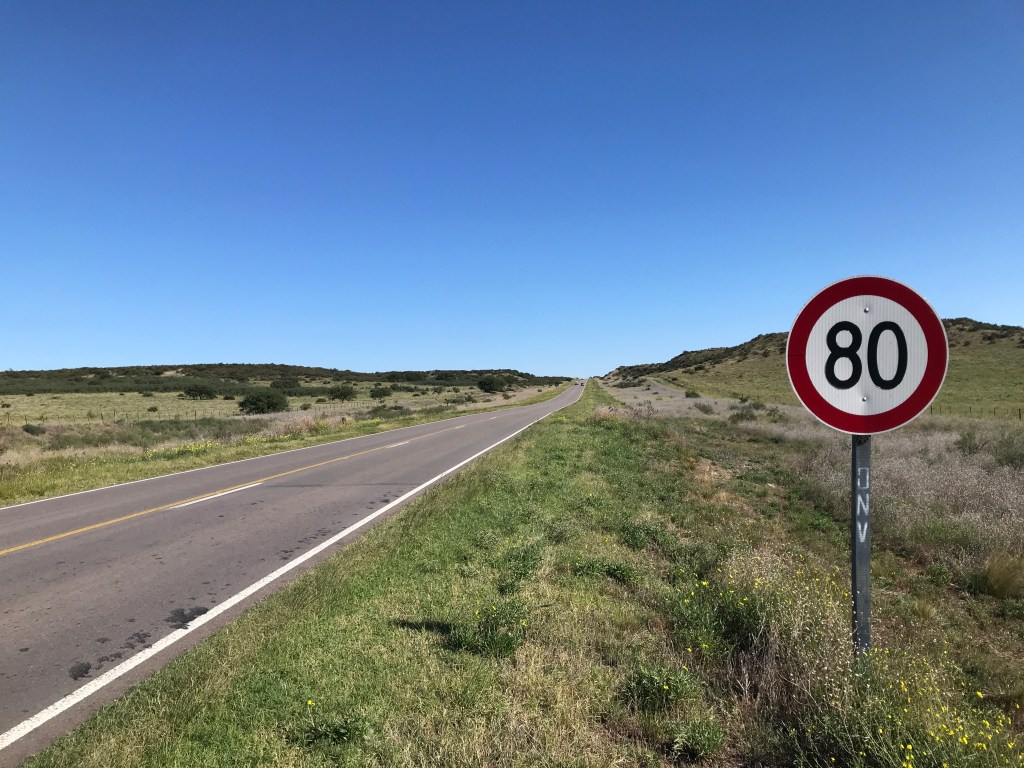
Now the sun was considerably brighter, and I flipped my hood up over my hat to shade my neck. More Long-tailed Meadowlarks with white underwings. Great Pampas-Finches. More sun. Two Swainson’s Hawks circled overhead. A dead armadillo. Burrowing owls. A Tinamou flushed from the roadside. More Long-tailed Meadowlarks. The last sip of water. Okay, I stuck my thumb out in “the right direction” but kept walking in the direction I wanted to go, tempting fate.
And then after 5 more miles of walking, I saw it. Holy Cow. Some of the worst pictures I’ve gotten of a bird, but definitely diagnostic! What a huge load off my shoulders! Talk about the fallacy of sunk costs, all that walking I’d done DEFINITELY caused me to see the bird.
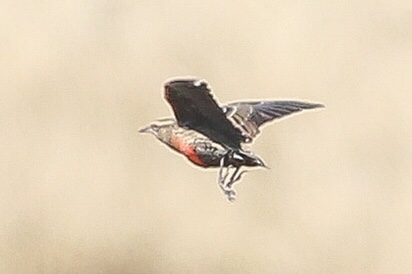
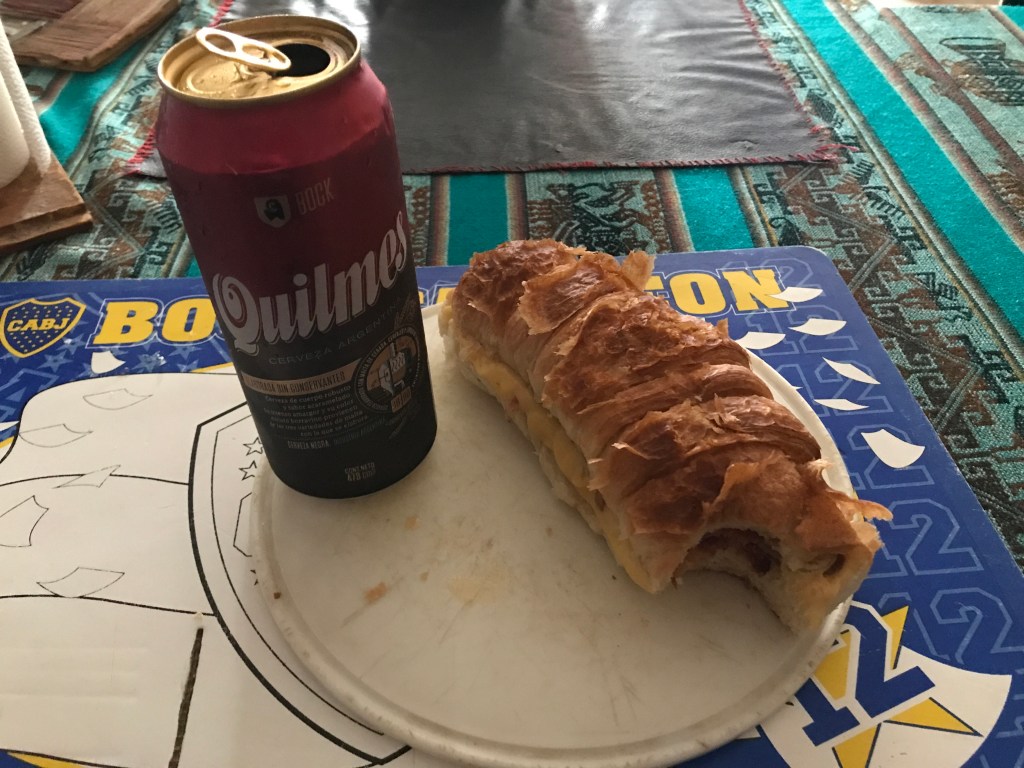
I started walking in the right direction AND thumbing in the right direction. It only took about 30 minutes for someone to stop this time. A couple of ranchers headed into Bahia Blanca to check on the calves they had sent to market. They were pretty stoked to learn there was a bird that could pretty much ONLY be found in their hometown, and duly unimpressed when I showed them the photo. Nonetheless, they thought it was pretty neat that I’d made my way 30 miles out of the city with the sole goal of seeing this bird. They dropped me off in Bahia Blanca at 2pm and I had my first food of the day, a ham and cheese sandwich with a Quilmes beer.
That night I hopped on the 14-hr bus to Bariloche, leaned the chair back and fell asleep. I woke up at about 10am the next morning to find that the bus was completely out of oil somehow, and had stopped in the middle of the desert! Fair enough. Eventually the company mechanic made it out and we were on our way again. I got into Bariloche at around 6pm. It was chilly, and the lake and mountains were a beautiful sight; I couldn’t wait to get started with Andean birding. Thanks for reading!


 Backcountry Birding
Leave a comment